Can You Bring a Power Bank on a Plane? TSA and Airline Rules Explained
Can You Bring a Power Bank on a Plane? TSA and Airline Rules Explained
A power bank can usually fly, but it must stay in your carry-on bag. The key checks are its watt-hour rating, battery condition, and airline policy. A power bank in checked baggage can be removed or refused.
You’ll also need to protect its terminals from accidental contact.
As of 2026, the common limit is 100 watt-hours without special airline approval. Watt-hours measure the battery’s stored energy, while milliamp-hours measure capacity at a stated voltage. Check the label before packing, then follow the decision path below.
Can You Bring a Power Bank on a Plane? TSA and Airline Rules Explained
Yes, you can usually bring a power bank on a plane. Pack it in carry-on baggage only. Batteries up to 100 Wh generally need no airline approval.
Larger batteries may need approval. Damaged batteries should never travel.
Check the Power Bank’s Watt-Hour Rating
The watt-hour rating determines which airline battery rule applies. Look for a number followed by “Wh” on the power bank or its packaging. If the label shows only milliamp-hours, you can calculate the watt-hours using the battery’s voltage.
How to Convert mAh to Wh
Use this formula:
Wh = mAh × volts ÷ 1,000
Most consumer power banks use lithium-ion cells with a nominal voltage of about 3.7 volts. For example, a 20,000 mAh power bank works out like this:
20,000 × 3.7 ÷ 1,000 = 74 Wh
That falls below the common 100 Wh threshold.
A 26,800 mAh power bank equals about 99 Wh at 3.7 volts. That capacity is close to the limit, so use the manufacturer’s printed Wh rating when available. Don’t rely on a rounded capacity printed in large text if a separate specification label gives a more precise figure.
What the 100 Wh and 160 Wh Limits Mean
Use this simple rule:
- Up to 100 Wh: Usually allowed in carry-on baggage without airline approval.
- More than 100 Wh and up to 160 Wh: Usually requires airline approval before travel.
- More than 160 Wh: Generally prohibited for passenger aircraft.
The U.S. Transportation Security Administration applies screening rules, while the Federal Aviation Administration governs many aviation safety requirements. The airline can also set stricter limits, including limits on the number of spare batteries you may carry.
If the capacity label is missing, damaged, or unreadable, security staff may not be able to verify the battery. In that case, the power bank could be refused even if its actual capacity would normally qualify.
Where to Pack a Power Bank: Carry-On vs. Checked Baggage
Pack every power bank in your carry-on bag, never in checked baggage. A power bank is treated as a spare lithium-ion battery because it isn’t installed inside the device it powers.
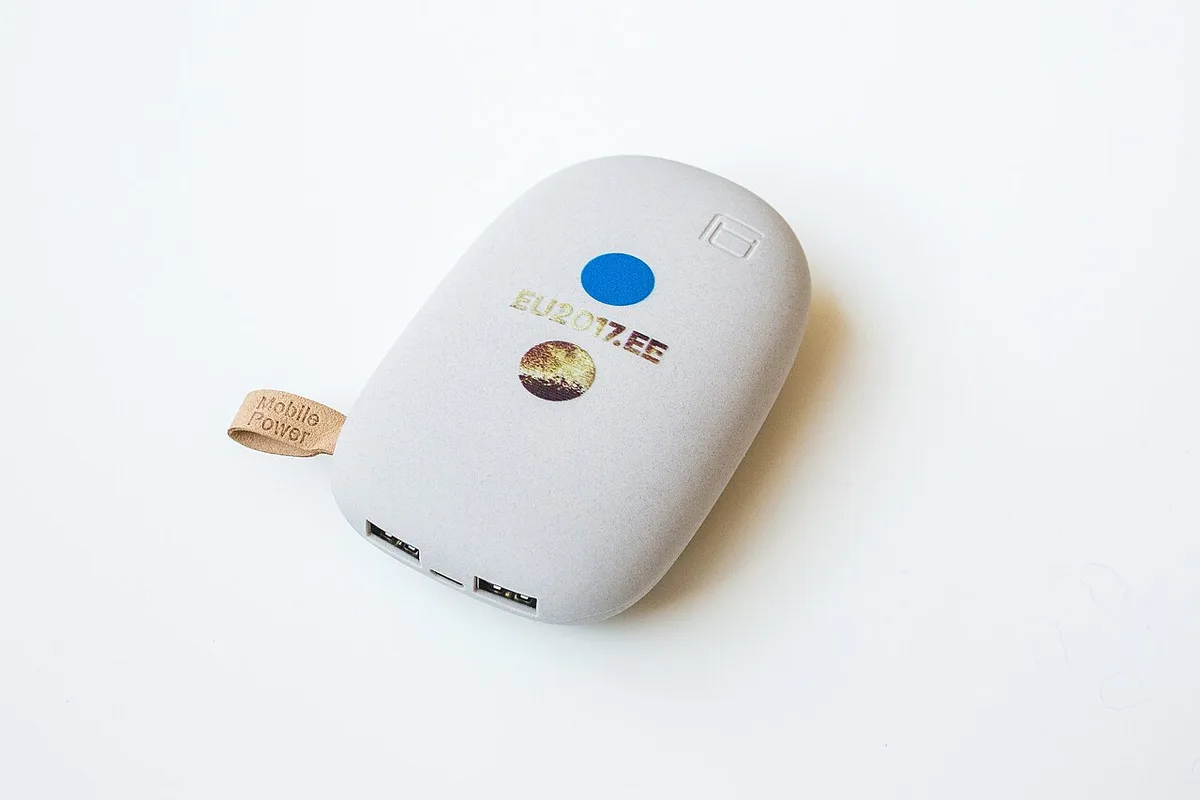
Image source: Wikimedia Commons / EU2017EE Estonian Presidency (CC BY)
The reason is fire safety. If a lithium-ion battery overheats or enters thermal runaway in the cabin, crew members can respond quickly. A battery hidden in the aircraft’s cargo hold is much harder to identify and manage.
Keep the battery accessible during the journey. A small pouch, electronics organizer, or protective case helps prevent the terminals from touching coins, keys, cables, or other metal objects.
Protecting Battery Terminals
Before leaving for the airport:
- Inspect the power bank for cracks, swelling, leaks, or unusual heat.
- Place it in a protective pouch or separate pocket.
- Cover exposed ports or terminals if the design allows it.
- Keep the capacity label visible.
- Avoid packing it beside loose metal objects.
- Remove it before handing over a carry-on bag for gate checking.
A USB-C power bank with covered ports still needs careful packing. The charging ports aren’t usually exposed battery terminals, but loose cables and metal items can press against the connector or damage the casing.
What to Do If Your Carry-On Is Gate-Checked
Remove the power bank before your carry-on goes into the aircraft hold. Put it in a personal item that stays with you, such as a small backpack or laptop bag.
This step matters because gate-check instructions can happen quickly. Don’t assume airline staff will find and remove spare batteries for you. If you’re carrying several devices, organize batteries together before reaching the gate.
TSA Rules vs. Airline-Specific Restrictions
TSA screening rules and airline operating rules work together, but they aren’t identical. TSA decides whether an item can pass through airport security. The airline controls how batteries are carried and used during the flight.
For a U.S. trip, check both sources before departure:
- TSA guidance for screening and baggage placement.
- FAA PackSafe guidance for lithium battery safety.
- The operating airline’s baggage and dangerous-goods policy.
- Each airline’s rules on a connecting itinerary.
The operating carrier matters most. A codeshare flight may show one airline during booking but be operated by another. Check the airline named beside “operated by” on your itinerary.
U.S. Domestic Flights
For most U.S. domestic flights, a power bank up to 100 Wh can travel in your carry-on without individual approval. A battery between 100 Wh and 160 Wh normally needs airline approval.
Airlines may add quantity limits or require you to keep spare batteries in a visible location. Some carriers also restrict using or charging power banks during the flight. Follow the crew’s instructions even if TSA allowed the battery through screening.
International Flights and Connecting Airlines
International travel adds another layer. Your departure airport may follow one set of screening procedures, while a connecting airport applies another. The airline may also follow the rules of its home aviation authority.
Check every airline on the itinerary, especially if you have separate tickets. If the rules conflict, follow the strictest practical requirement. Keep the power bank in your cabin bag, retain its original capacity label, and avoid carrying a high-capacity model without written airline approval.
Can You Use or Charge a Power Bank During a Flight?
You may be allowed to use a power bank during a flight, but airline policies vary. Some airlines prohibit using or charging portable chargers onboard because of lithium battery fire concerns.
Check the operating airline’s current policy before boarding. Crew instructions always take priority. If staff tell you to unplug or store the power bank, do so immediately.
Airline and Cabin-Crew Instructions
Don’t connect a power bank during takeoff, landing, turbulence, or any period when crew members ask passengers to stow electronics. A cable can snag, and a loose battery can slide under a seat.
Some airlines restrict power banks in overhead bins. Others ask passengers to keep them where they can be seen or reached. A seat pocket or small personal bag is often more practical than the bottom of a full backpack.
Avoid leaving a power bank charging unattended. Stop using it if it becomes unusually hot, smells strange, swells, or makes a popping sound. Alert cabin crew and don’t place a damaged battery in a seat pocket or overhead compartment.
Keeping the Battery Accessible in the Cabin
For a smooth flight:
- Charge your devices before boarding.
- Keep the power bank in your personal item.
- Use a short, undamaged charging cable.
- Don’t cover the battery with clothing or other soft items.
- Disconnect it when your phone reaches the needed charge.
- Follow the airline’s onboard battery instructions.
A USB-C power bank may support fast charging, but higher output doesn’t change its baggage classification. Capacity is based on stored energy in watt-hours, not the number of ports or charging speed.
Damaged Batteries, Recalled Chargers, and Mistakes to Avoid
Don’t take a power bank on a plane if it’s swollen, cracked, leaking, unusually hot, or giving off an odd smell. These signs can point to internal damage, which raises the risk of overheating or thermal runaway.
Stop using the battery and keep it away from flammable materials. Don’t put a damaged power bank in checked baggage, carry-on baggage, or household trash. Contact the manufacturer or your local hazardous-waste service for disposal instructions.
Signs a Power Bank Shouldn’t Fly
Check the unit before every trip. Remove it from your travel bag if you notice:
- A bulging or distorted case
- Cracks, punctures, or melted plastic
- Corrosion around a port
- Smoke, hissing, or a chemical smell
- Rapid heating during normal charging
- A battery that loses charge unusually fast
- A product listed in a safety recall
A power bank that no longer works may still contain stored energy. Don’t open the casing or attempt a cell replacement at home. Manufacturer specifications and recall notices provide safer guidance than informal repair advice.
Common Packing and Screening Errors
The most common mistake is placing a portable charger in checked luggage. Other problems include carrying a battery with no readable capacity label, leaving it loose beside keys, and forgetting it inside a bag that gets gate-checked.
Before traveling, review your airline’s battery policy and keep the charger easy to reach. If you’re troubleshooting a USB-C accessory that won’t charge correctly, check the connection basics before assuming the airline caused the problem.
Power Bank Flight Rules: Final Decision Guide
Use this checklist before leaving for the airport:
- If the power bank is damaged, swollen, leaking, or recalled, don’t bring it.
- If it’s in checked baggage, remove it and place it in your carry-on.
- If it’s up to 100 Wh, it usually needs no airline approval.
- If it’s above 100 Wh and up to 160 Wh, contact the airline first.
- If it exceeds 160 Wh, leave it at home.
- If the capacity label is missing, choose another battery with clear markings.
- If your airline bans onboard use, keep the power bank unplugged during flight.
A standard 10,000 mAh power bank is usually well below 100 Wh. A 20,000 mAh model is also commonly below that threshold at a nominal 3.7 volts. Capacity still needs checking because voltage and manufacturer labeling can vary.
Keep the battery in a protective pouch or separate pocket. If your carry-on gets gate-checked, remove the power bank before handing over the bag. This small step prevents the most common packing error.
For international trips, check the operating airline, connecting carriers, and departure airport. If one policy is stricter, follow that rule. Save the airline’s current battery guidance on your phone in case staff ask about the rating.
Frequently Asked Questions
Can a 20,000 mAh power bank go on a plane?
Yes, most 20,000 mAh power banks can travel in carry-on baggage. At a typical 3.7-volt rating, 20,000 mAh equals about 74 Wh. Check the printed watt-hour rating, protect the battery from contact with metal objects, and follow the operating airline’s quantity and onboard-use rules.
Can you put a power bank in checked luggage?
No, spare power banks should not go in checked luggage. Pack them in your carry-on or personal item instead. If an airline employee checks your cabin bag at the gate, remove every power bank and loose lithium battery before the bag enters the aircraft hold.
Can you bring more than one power bank?
Usually, yes, but airlines may limit the number of spare lithium-ion batteries. Keep each power bank within the allowed capacity and pack them separately to prevent short circuits. Check the airline’s current policy before carrying several batteries, especially on international or connecting flights.
What happens if the capacity label is missing?
A missing or unreadable label can prevent security staff from verifying the battery’s watt-hour rating. The power bank may be refused, even if its actual capacity is within the limit. Choose a unit with clear manufacturer markings and keep its original specifications available when traveling.
Can you use a power bank during a flight?
Only if the airline and cabin crew allow it. Some carriers restrict using or charging portable chargers onboard. Keep the battery accessible, disconnect it when instructed, and stop using it immediately if it becomes hot, swollen, smoky, or damaged.